Last reviewed:
How does the CAC 40 govern AI? What its official filings say
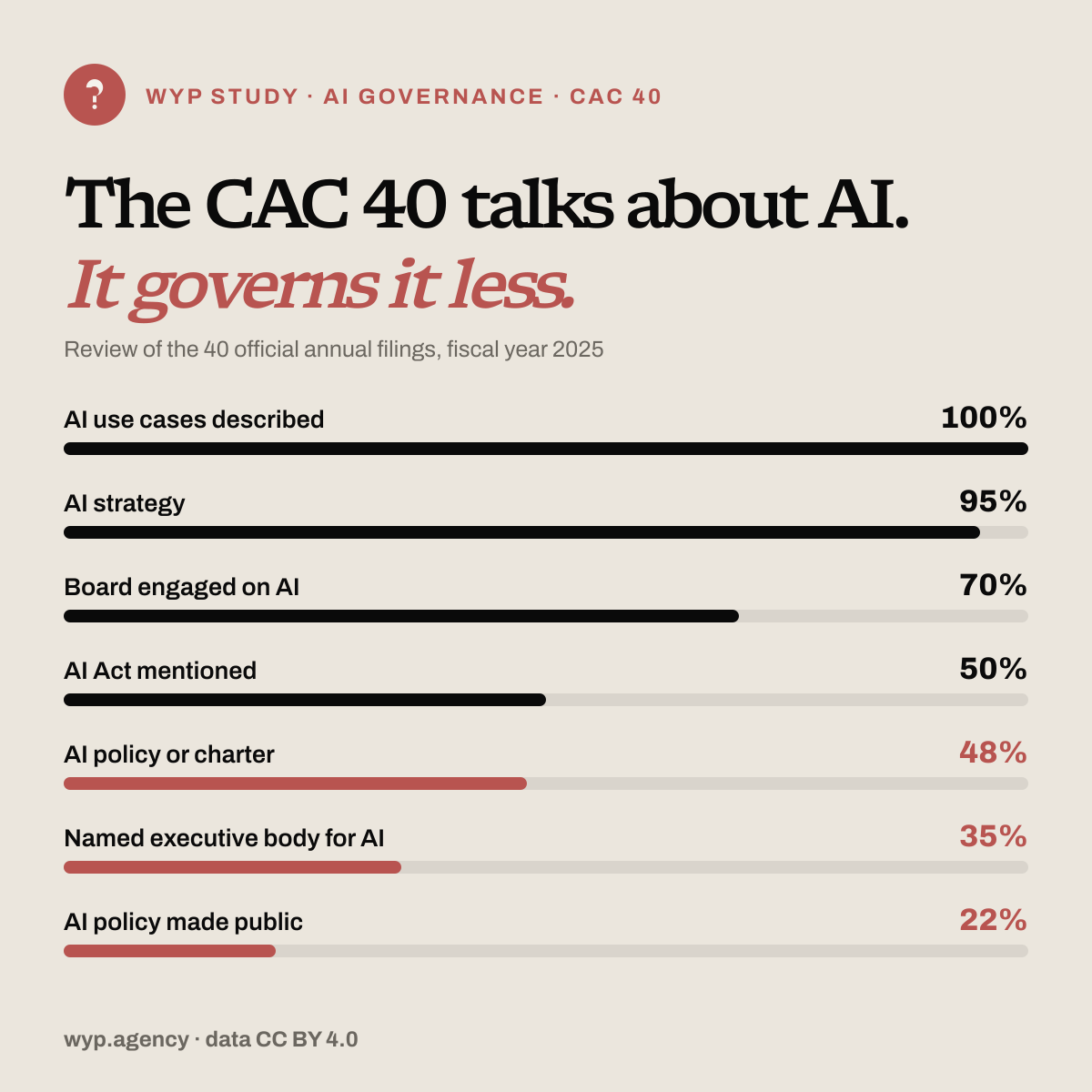
In their fiscal 2025 universal registration documents, all 40 CAC 40 companies describe uses of artificial intelligence and 38 set out an AI strategy. Yet only 19 mention an AI policy or charter, 9 say they have made it public, and 14 name an executive body in charge of steering AI (WYP.agency study, October 2026).
This study reviews the 40 official annual filings of the CAC 40 (fiscal year 2025, published in 2026) against 13 AI governance criteria, 9 of which follow the European study Decoding AI Disclosure (FTI Consulting and Trinity College Dublin). It measures what companies disclose, not what they do: every positive answer is backed by a quotation and its page.
WYP.agency study · 40 universal registration documents, FY2025 · October 2026
01The finding
AI is everywhere in CAC 40 filings. The framework that governs it, much less so.
Large companies readily explain what AI brings them. They say much less about who is accountable for it. A strategy without a policy or a named owner leaves every team to decide alone.
02The 13 criteria
Share of the 40 companies disclosing each governance element in their official annual filing.
03Boards engage, management organises less
In 28 companies, the board or one of its committees dealt with AI during the year. But only 14 name a body or role steering AI group-wide (AI committee, Chief AI Officer, AI department). And 20 mention the AI Act, whose obligations are phased in until 2028.
04Employees and generative AI
24 companies describe a generative AI tool provided to employees or usage rules. 16 say nothing about how their staff use ChatGPT, Copilot or similar tools. That is where shadow AI starts: two thirds of office workers have used an AI tool they believed was prohibited (Shadow AI Barometer 2026).
05Compared with large European companies
Indicative comparison with Decoding AI Disclosure (FTI Consulting and Trinity College Dublin, November 2024) on the 50 STOXX Europe 50 companies and their 2023 reports. Scope, year and documents differ.
| Criterion | CAC 40, FY2025 filings | STOXX Europe 50, 2023 reports |
|---|---|---|
| AI policy or charter | 48% | 38% |
| Board engaged on AI | 70% | 46% |
| Named executive body for AI | 35% | 48% |
| AI training | 80% | 52% |
| Assessment or audit of AI systems | 38% | 6% |
| AI strategy | 95% | 100% |
| AI risk management | 70% | 40% |
| Quantified AI indicator | 78% | 26% |
| AI use cases described | 100% | 84% |
06The 40 companies
● = disclosed in the official annual filing (quotation and page in the dataset); · = not found. Alphabetical order.
| Company | Pol. | Pub. | Board | Exec. | Train. | Assess. | Strat. | Risk | KPI | Use | RF | AI Act | Staff | Criteria |
|---|---|---|---|---|---|---|---|---|---|---|---|---|---|---|
| Accor | · | · | · | · | · | · | ● | ● | ● | ● | ● | · | · | 5/13 |
| Air Liquide | ● | · | ● | ● | ● | ● | ● | ● | ● | ● | ● | ● | · | 11/13 |
| Airbus | · | · | ● | ● | ● | · | ● | · | ● | ● | · | · | ● | 7/13 |
| ArcelorMittal | · | · | · | · | ● | · | ● | · | ● | ● | ● | · | · | 5/13 |
| AXA | ● | ● | ● | ● | ● | ● | ● | ● | ● | ● | ● | ● | ● | 13/13 |
| BNP Paribas | · | · | ● | ● | ● | ● | ● | ● | ● | ● | · | ● | ● | 10/13 |
| Bouygues | ● | · | ● | ● | ● | · | ● | ● | ● | ● | ● | · | ● | 10/13 |
| Bureau Veritas | ● | · | ● | ● | ● | ● | ● | ● | ● | ● | ● | · | ● | 11/13 |
| Capgemini | ● | ● | ● | ● | ● | ● | ● | ● | ● | ● | ● | ● | ● | 13/13 |
| Carrefour | · | · | · | ● | ● | · | ● | ● | ● | ● | ● | ● | ● | 9/13 |
| Crédit Agricole S.A. | · | · | ● | · | ● | ● | ● | · | ● | ● | ● | · | ● | 8/13 |
| Danone | · | · | ● | · | ● | · | ● | · | · | ● | ● | · | · | 5/13 |
| Dassault Systèmes | ● | ● | · | ● | ● | ● | ● | ● | · | ● | ● | · | · | 9/13 |
| Eiffage | · | · | ● | ● | ● | ● | ● | ● | ● | ● | ● | ● | ● | 11/13 |
| Engie | · | · | ● | · | · | · | ● | · | · | ● | ● | ● | · | 5/13 |
| EssilorLuxottica | ● | · | ● | · | · | · | ● | ● | ● | ● | ● | ● | · | 8/13 |
| Eurofins Scientific | · | · | · | · | · | · | ● | · | · | ● | ● | · | · | 3/13 |
| Euronext | · | · | ● | · | ● | · | ● | ● | ● | ● | ● | ● | ● | 9/13 |
| Hermès International | · | · | ● | · | · | ● | · | ● | · | ● | ● | · | · | 5/13 |
| Kering | · | · | · | · | · | · | ● | ● | ● | ● | ● | ● | · | 6/13 |
| L'Oréal | ● | ● | ● | · | ● | ● | ● | ● | ● | ● | ● | · | ● | 11/13 |
| Legrand | · | · | · | · | ● | · | ● | · | ● | ● | ● | · | · | 5/13 |
| LVMH | ● | · | ● | · | ● | · | · | · | · | ● | · | · | · | 4/13 |
| Michelin | ● | ● | ● | · | ● | · | ● | ● | ● | ● | ● | · | ● | 10/13 |
| Orange | ● | ● | ● | ● | ● | ● | ● | ● | ● | ● | ● | ● | ● | 13/13 |
| Pernod Ricard | ● | · | · | · | ● | ● | ● | ● | ● | ● | ● | ● | ● | 10/13 |
| Publicis Groupe | ● | ● | ● | · | ● | ● | ● | ● | ● | ● | ● | ● | ● | 12/13 |
| Renault | ● | · | · | · | ● | · | ● | ● | · | ● | · | ● | ● | 7/13 |
| Safran | · | · | ● | ● | ● | · | ● | ● | ● | ● | ● | ● | ● | 10/13 |
| Saint-Gobain | · | · | · | · | ● | · | ● | · | ● | ● | · | · | ● | 5/13 |
| Sanofi | ● | · | ● | · | ● | · | ● | ● | ● | ● | ● | ● | ● | 10/13 |
| Schneider Electric | ● | ● | ● | ● | ● | ● | ● | ● | ● | ● | ● | · | ● | 12/13 |
| Société Générale | · | · | ● | · | ● | · | ● | ● | ● | ● | ● | ● | ● | 9/13 |
| Stellantis | · | · | · | · | ● | · | ● | · | · | ● | ● | ● | · | 5/13 |
| STMicroelectronics | ● | ● | · | · | · | · | ● | · | · | ● | ● | ● | ● | 7/13 |
| Thales | ● | · | ● | · | · | · | ● | ● | ● | ● | ● | · | · | 7/13 |
| TotalEnergies | · | · | ● | · | ● | · | ● | · | ● | ● | ● | · | ● | 7/13 |
| Unibail-Rodamco-Westfield | · | · | ● | · | ● | · | ● | ● | ● | ● | ● | · | · | 7/13 |
| Veolia Environnement | ● | · | ● | ● | ● | ● | ● | ● | ● | ● | ● | ● | ● | 12/13 |
| Vinci | · | · | ● | · | ● | · | ● | ● | ● | ● | ● | · | · | 7/13 |
07Method and data
- Scope: official CAC 40 composition on 16 October 2026 (Euronext). FY2025 universal registration document; 2025 annual report for Airbus, ArcelorMittal, Eurofins, Euronext, Stellantis and STMicroelectronics; year ended 30 June 2026 for Pernod Ricard.
- What is measured: disclosure, not practice. “Not found” does not mean “does not exist”.
- Checks: exact quotation and page for every positive answer, verified by script; second search in French and English for every negative answer; written decision rules; independent cross-check of 10 randomly drawn companies.
- Right of reply: any company may point out an omitted passage; corrections will be dated on this page.
- Open data: download the dataset (CSV, CC BY 4.0), with page and quotation for each company and criterion.
FAQ
How many CAC 40 companies have an AI policy?
19 of 40 (48%) mention an AI-specific policy, charter or principles in force in their FY2025 filing. 9 say the text is publicly available.
Do CAC 40 boards oversee AI?
Yes, in 28 of 40 companies (70%): a board or committee session, seminar, review or director training on AI during the year. Director biographies and skills matrices are not counted.
Is the CAC 40 preparing for the AI Act?
20 of 40 companies (50%) mention the EU AI Act in their annual filing. Its obligations are phased in from 2025 to 2028: transparency since August 2026, high-risk systems from December 2027 (timeline adjusted by the 2026 Digital Omnibus).
How was the study carried out?
Review of the 40 FY2025 universal registration documents (annual report for the 5 non-French companies), extraction of AI passages, coding of 13 criteria with quotation and page, a second search for every negative answer, and an independent cross-check of 10 randomly drawn companies. Data under CC BY 4.0.
See also
Further reading
Decoding AI Disclosure (FTI Consulting, Trinity College Dublin)
Sources
- FTI Consulting et Trinity College Dublin, « Decoding AI Disclosure », 25 novembre 2024. https://www.tcd.ie/media/tcd/business/research/Decoding-AI-Disclosure-Report.pdf
- Forum pour l'Investissement Responsable, « Assemblées générales 2025 : comment le CAC 40 répond-il ? », janvier 2026. https://www.frenchsif.org/isr_esg/wp-content/uploads/FIR_Rapport-S6-AG2025_23.01.2026.pdf
- Euronext, composition de l'indice CAC 40 (FR0003500008) au 16 octobre 2026. https://live.euronext.com/fr/product/indices/FR0003500008-XPAR/market-information
- AMF, base des décisions et informations financières (dépôts ESEF des DEU 2025). https://bdif.amf-france.org/
- Règlement (UE) 2024/1689 sur l'intelligence artificielle (AI Act), EUR-Lex. https://eur-lex.europa.eu/eli/reg/2024/1689/oj